Design principles validated against public sentiment data before a single screen was designed, not against a built product. A research-informed exploration of the design principles required for trustworthy AI-assisted communication in brain injury rehabilitation. The Digital Twin Advocate (DTA) is a concept for a personalised AI companion, grounded in analysis of over 5,000 Reddit posts about digital twins and AI companions.
After a stroke or traumatic brain injury, some patients stay fully aware but lose the ability to speak or gesture reliably. Families and clinicians are left interpreting small physical signals, and what gets lost isn't just communication, it's recognition.
The Digital Twin Advocate (DTA) is a concept for a personalised AI companion trained on a patient's pre-injury voice, expressions and communication history, designed to help them communicate again during rehabilitation. It isn't an autonomous replacement. It's designed to look to the patient for signals of comfort, confusion or consent before it speaks on their behalf.
Before any interaction could be designed, a harder question needed answering: would patients, families and clinicians trust an AI companion speaking for someone who can't speak for themselves? Introduced badly, this kind of technology risks feeling like automation rather than empathy, which does more harm than the silence it's meant to solve.
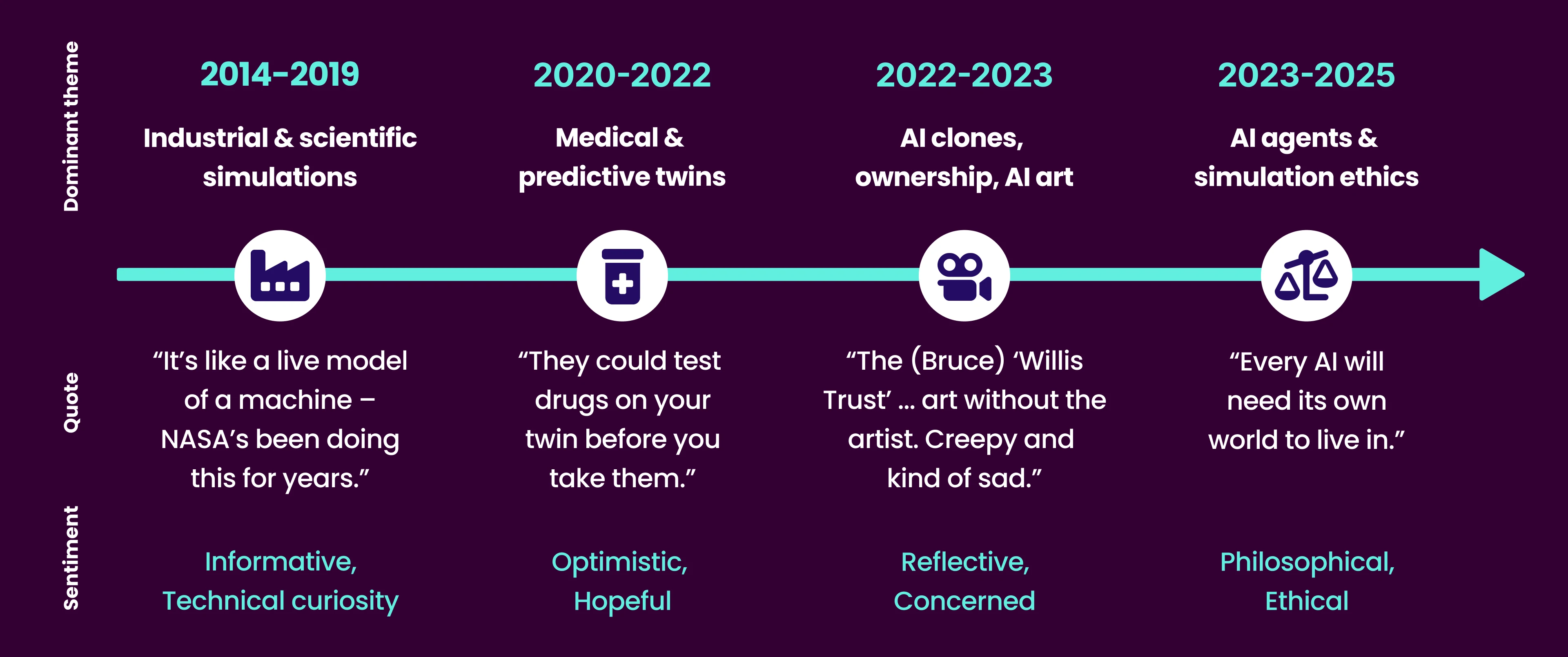
Rather than starting from assumptions about AI acceptance, the project started with what people already say when nobody's asking them a survey question. Phase one examined how public conversation about digital twins evolved between 2014 and 2025 across engineering, medical, creative and AI-agent contexts, using Communalytic to collect around 900 Reddit comments and semantic clustering to group recurring topics and attitudes by time period.
Phase two narrowed the lens to assistive AI and brain injury care specifically: 4,343 posts and comments (2014–2025) across r/TBI, r/AssistiveTechnology, r/technology, r/artificialinteligence and r/artificial, coded into six themes covering framing, healthcare use, empathy, identity and ethics, autonomy, and trust and privacy.
| Theme | Focus | Quote |
|---|---|---|
| Technical curiosity | Explaining how digital twins work. Fascination with the technology. | "The important thing is that it has constant operation data… makes the simulation accurate." – AtrociousMeandering, Dec 2024 |
| Biomedical optimism | Positive potential of digital twins in medicine and health prediction. | "They could test drugs on your twin before you take them." – User comment, 2023 |
| Identity and ownership | AI clones, likeness, control. | "No, but your digital clone will." – WhatTheZuck420, Sept 2022 |
| Creativity and art | AI authorship and originality. | "The whole purpose of art is the thought and precision that goes into creating it… this is a huge hit for anyone that appreciates true art." – whatsthewordguys, Jul 2023 |
| Simulation and agents | Omniverse, training environments. | "Every AI will need its own world to live in." – r/artificial, 2024 |
| Ethics and trust | Privacy and autonomy concerns. | "What are the chances this stuff gets hacked and we see people's likeness in weird videos?" – bottledsoi, Sept 2022 |
| Theme | Mentions |
|---|---|
| Robot vs ally framing | 1,352 |
| Healthcare use | 1,135 |
| Empathy and companionship | 765 |
| Identity and ethics | 527 |
| Control and autonomy | 323 |
| Framing term | Mentions |
|---|---|
| Ally | 1,205 |
| Friend | 221 |
| Robot | 33 |
| Advocate | 32 |
| Android | 32 |
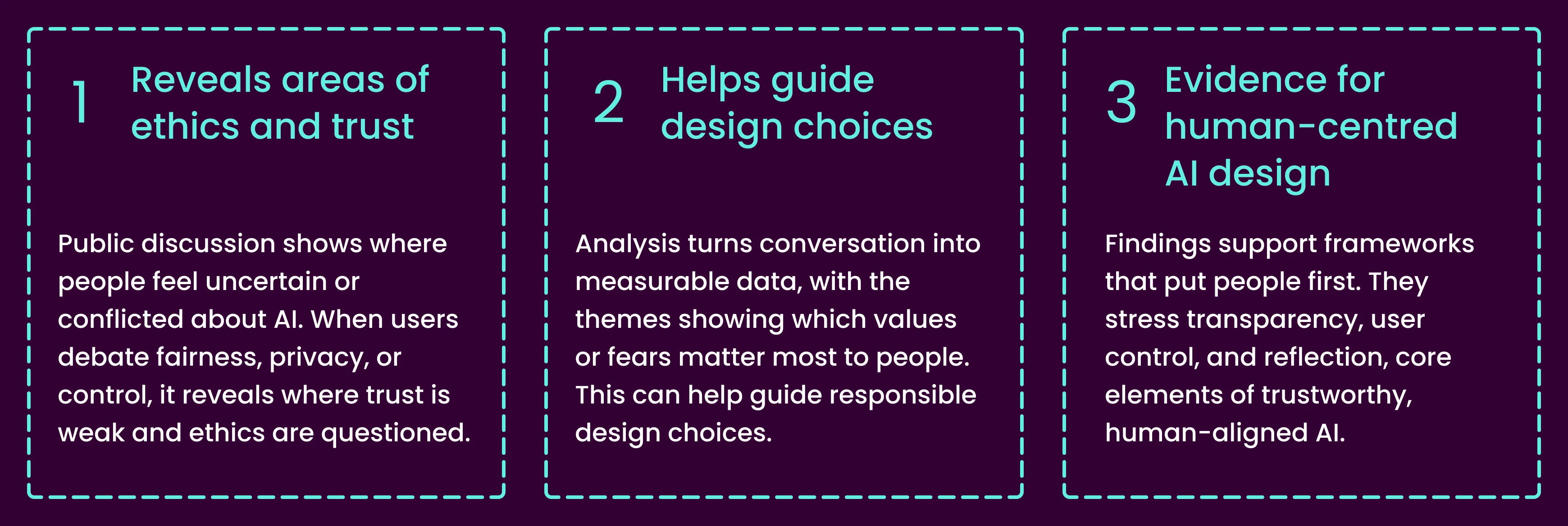
Each recommendation below traces back to a specific pattern in the data rather than a general assumption about what makes AI feel trustworthy.
| Focus area | Recommendation | Rationale |
|---|---|---|
| Language and branding | Frame the DTA as a compassionate ally, not a machine. Language such as "your voice, remembered." | "Ally" and "friend" correlate with strongly positive sentiment; "robot" and "clone" evoke fear and resistance. |
| Consent and transparency | An interactive dashboard showing what data is used, where it came from, and how to change permissions. | Responds directly to the trust and privacy theme running through every subreddit. |
| Human-in-the-loop design | The companion visually confirms patient cues before acting, e.g. "I think that's a yes. Is that right?" | Keeps the patient, not the system, at the centre of every decision. |
| Emotional feedback | Tone, pacing and expression adjust based on patient fatigue or discomfort. | Reinforces adaptive empathy rather than a fixed, scripted response. |
| Family engagement | Families are involved in onboarding to build shared understanding of how advocacy works. | Families need reassurance, not just the patient. |
| Governance and oversight | An ethics review of data management and transparency on a regular cycle. | Ensures accountability doesn't rely on goodwill alone. |
| Communication strategy | Tell stories about regained agency, not technical capability. | Converts innovation into emotional value people can relate to. |
Every naming and messaging decision was tested against the sentiment data before use. "Ally" and "advocate" carry the trust the data shows; "robot" and "clone" carry the resistance. This shaped the product name itself, not just its marketing copy.
The control and autonomy theme was the clearest signal in the data: people want help, not to be overridden. The DTA is designed to visually confirm a patient's cue before speaking on their behalf, keeping every decision anchored to patient consent.
Trust and privacy concerns appeared across every subreddit analysed, including ones with no healthcare focus at all. A consent dashboard puts what data is used, and how to change it, in plain view for the patient and family instead of buried in a settings menu.
Community discussion showed that acceptance depends on more than the patient's trust. Families raised the same concerns about identity and control. Bringing them into onboarding, instead of treating them as bystanders, was a direct response to that pattern.
A short scenario written to test the concept against a real interaction: a patient in rehabilitation, unable to speak, stiffens slightly when she wants her companion to speak for her. It studies her expression for confirmation before continuing, and pauses the moment she tenses. This is the interaction the design principles above are built to support, not a documented outcome.
This project is a research-informed concept, not a built or tested system. Each design principle below is checked against the two rounds of Reddit analysis it came from.
Two rounds of Reddit analysis (around 900 comments, then 4,343 posts across five subreddits) surfaced consistent patterns: "ally" language appearing far more frequently than "robot" language (more than 36 to 1 in mention counts), and control and autonomy as the dominant concern across every community studied. Each design principle traces directly to one of these patterns.
Whether patients, families, or clinicians would actually trust the DTA in practice. Reddit users skew technically literate and don't necessarily reflect the attitudes of people directly affected by brain injury, and automated thematic coding captures sentiment patterns rather than deeper emotional nuance. These principles are hypotheses to test, not validated outcomes.
The value of this project is in showing how large-scale public sentiment research can directly shape ethical, trustworthy design principles for AI in a sensitive care setting, before a single screen is designed. The next step is direct engagement: interviews with rehabilitation patients, families and clinical teams, and testing the human-in-the-loop interaction pattern with people who would actually rely on it.