An educational conversation that helps adults explore schema therapy concepts through guided reflection and a practical coping skill. Built in Voiceflow, Schema Compass guides adults through a structured conversation with Mira, a cat character, ending in a personalised reflection they can revisit. It's a self-directed learning experience, not a clinical or therapeutic one. The project demonstrates needs analysis, conversational learning design, accessibility decision-making, and iterative development based on user testing.
Chat with Mira in the widget in the bottom corner. Takes about five minutes. This is under active development, so the live version may differ slightly from what's described below.
Schema therapy is a well-evidenced framework for understanding why people think, feel, and behave the way they do, but the goal for a lay person isn't to learn the whole framework. It's to recognise the one pattern behind how they're feeling right now. That's hard because the concepts are highly interconnected: each schema links to an unmet need, a set of triggers, a thinking distortion, and one or more coping skills, and the workbooks and academic texts that map this out present it as a subject to master rather than a single pattern to find.
The design challenge was untangling that maze into a single guided path: one schema, one need, one skill at a time, so a lay person could recognise their own pattern without needing to learn the whole framework first.
Schema Compass is an educational tool, not a therapeutic one. All content was developed from primary sources (Young et al., 2003; Bricker and Young, 2020) and reviewed by a practising psychologist, who confirmed the educational framing was appropriate and expressed intent to recommend the tool to clients for use alongside therapy.
Adults exploring schema therapy concepts, arriving without clinical training and, often, without the vocabulary to describe what they're feeling beyond a single word. What they need from the experience:
A "How might we" brief framed the problem before solution development, and these four objectives were derived from it to define what success looks like for a learner completing the experience:
Recognise a difficult emotional pattern and choose a more helpful response.
Schema therapy is about applying a framework to lived experience, not memorising terminology. That requires reflection, personalisation, and guided questioning. A conversation can combine all three in a single sequence, adapting the next question to what the learner just said.
The alternative was a reference document: twenty schemas, laid out for a learner to read and self-diagnose. That asks a distressed reader to do the hardest part of the work themselves. Schema Compass inverts it into a single guided path, one schema, one need, one skill at a time, so a lay person recognises their own pattern without first learning the whole framework. Learners do not read about schemas; they apply the framework to their own experience as the conversation unfolds.
Mira was designed as a non-clinical guide to reduce anxiety and support reflection. User testing confirmed participants found the tone approachable and easier to engage with than a formal instructional voice, which matters when the content asks learners to examine their own patterns.
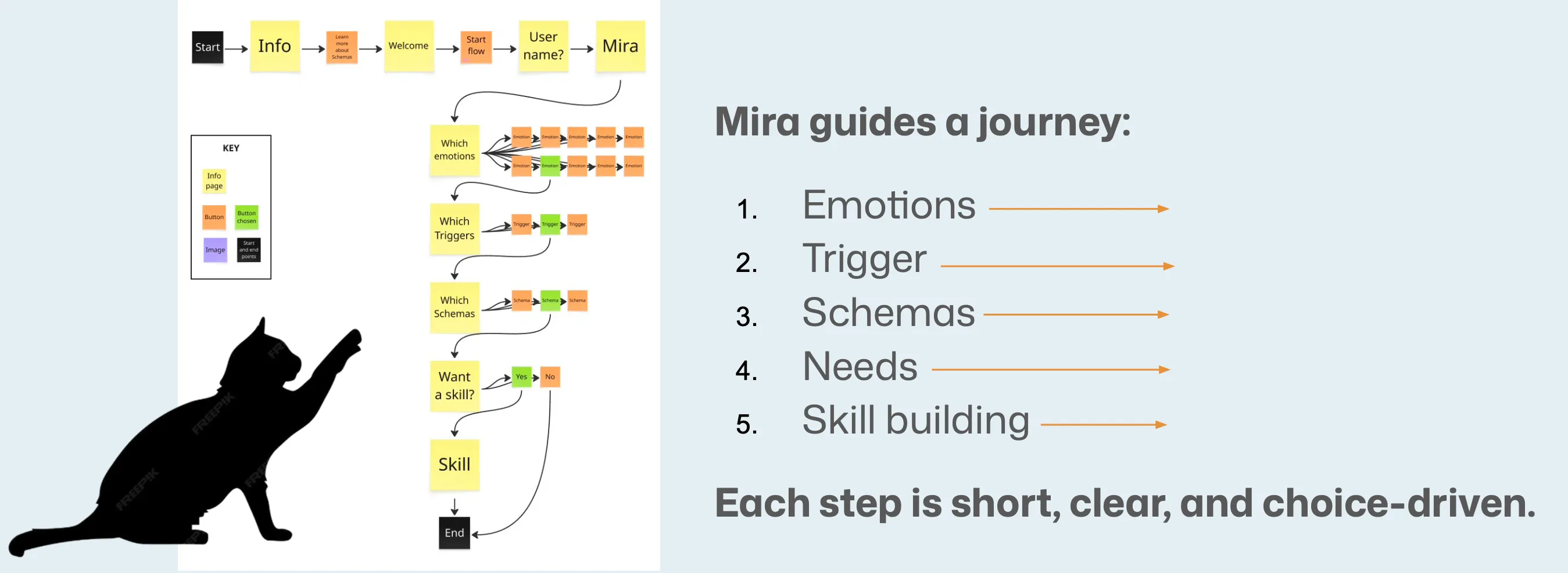
Each step mirrors the therapeutic process and corresponds to a learning objective, moving from emotion to a personalised reflection.
Mira greets the learner and presents a set of emotion buttons (anxious, sad, angry, ashamed, overwhelmed, lonely, frustrated, numb, guilty, hopeful) to choose from.
Based on the emotion selected, Mira presents likely triggers as buttons and asks what happened, or what the learner was thinking about.
Using the emotion and trigger together, Mira surfaces two to four likely schemas with a plain-English description of each for the learner to choose from.
Mira explains the selected schema in short warm paragraphs: its definition, common thoughts, feelings, behaviours, and the underlying need it points to.
Mira walks the learner through a matched coping skill one numbered step at a time, confirming each step before moving to the next.
Mira offers to save a personalised flashcard capturing the pattern's origin, thinking distortion, a healthier view, supporting evidence, and an alternative behaviour, asking a short follow-up only for anything she can't infer.
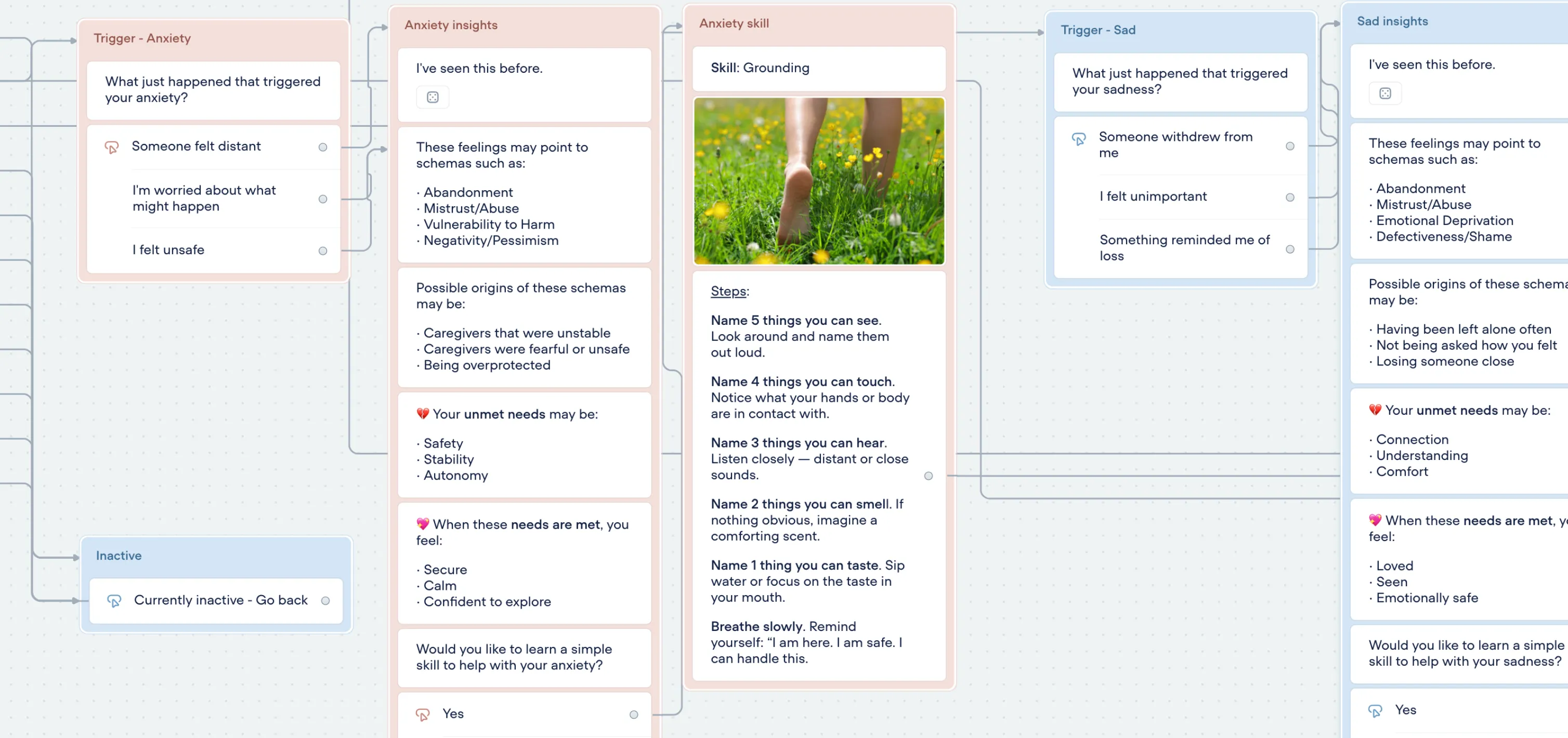
Twenty schemas are mapped across five domains with associated unmet needs, schema modes, and linked coping skills. This content model became the full Voiceflow conversation architecture, with every path reviewed for dead ends before any content was written.
The sequence follows the same order as the schema therapy framework because each step depends on the last. You cannot name a schema without first grounding it in an emotion and a trigger, and you cannot reflect on its origin and a healthier alternative until the schema and a coping skill have been established. The sequence is the pedagogy. Each step is a prerequisite for the next, one concept per exchange, so cognitive load stays manageable across emotionally demanding content.
Learners apply the framework to their own experience, not a hypothetical example. An illustrative path through the conversation:
Through guided questions, Mira surfaces the abandonment schema: a pattern of expecting to be excluded or left behind, along with the unmet need beneath it. She then walks through a matched grounding technique in plain steps: notice five things you can see, four you can touch, three you can hear, two you can smell, one you can taste. Move your body gently.
Before ending, Mira offers to save a flashcard: a short personalised summary capturing where the pattern was likely learned, the thinking distortion it creates, a healthier view, supporting evidence from the learner's own life, and an alternative behaviour to try next time, asking a quick follow-up only for anything she can't infer from the conversation.
The flashcard is the point where the session moves from reflection to something the learner can return to later.
Each conversation path ends with a coping skill matched to the schema and emotion the learner identified, with step-by-step instructions and a photograph. This is the transfer moment. Without it, the session is reflection without application.
Every response is written in plain language: warm, direct, non-clinical. Skill content is written for immediate practical use, with numbered steps rather than abstract guidance. Free text would require learners to already know the vocabulary of schema therapy, so buttons reframe the task to recognition rather than recall, and ensure every path reaches a completed skill and a personalised flashcard. The character functions as an instructional scaffold, guiding learners through reflective activities without creating the sense of being assessed or diagnosed, and gives the sequence a consistent guide from the first message to the flashcard.
Exploratory prototype validation with five testers, including a clinical psychologist. Structured protocol across three phases: before use, immediately after, and on reflection.
"It was well structured and clear. The cat assistance and lots of question prompts were what I liked most. I would like to see more skills and tools as options."
"Reasonably clear from the start. Entering my name was what frustrated me most."
"I felt very guided. The practical strategies were easy to use. Send it to me when it's fully up and running. I'll use it."
Alan's ratings were the most critical of the group, reflecting frustration with how limited the response options felt. Patrick raised a similar concern about functionality in writing but still rated the experience highly across the board.
| Measure (1–5) | Deb | Alan | Margi | Psychologist | Patrick |
|---|---|---|---|---|---|
| Ease of use | 5 | 4 | Easy* | 5 | 5 |
| Helpfulness | 5 | 2 | 3 | 5 | 5 |
| Engagement | 5 | 2 | 2 | 4 | 5 |
Two iterations were made directly from testing feedback:
| Finding | Design response |
|---|---|
| Name entry frustrated several testers before they could begin | Allowed single-character name input |
| Some testers found reading dense schema content harder to follow | Added voice playback so learners can listen instead |
| Alan and Patrick wanted broader response options | Identified as a priority for expanding the coping skills library |
| Closed-ended ratings couldn't confirm whether learning objectives were met | Proposed objective-linked evaluation for future testing |
Testing provided early evidence that the core interaction was understandable and approachable, while also identifying limits in the prototype's breadth and functionality. The most useful critique came from Alan and Patrick, whose expectation of broader functionality points to the gap between a proof of concept and a tool built for sustained engagement.
Formative testing with five participants, including a clinical psychologist. Ease of use was rated positively across the group, while helpfulness and engagement varied. Character voice confirmed appropriate by the psychologist, who asked to be sent the finished tool. Two iterations made directly from feedback: voice playback added, name input rules relaxed.
Whether participants could actually identify a schema or apply a coping skill - the close-ended rating questions couldn't test this. Sustained engagement beyond a single session. Future testing would use open prompts tied to the learning objectives instead.